
AI pre-qualification interviews: go beyond the CV.
Give every candidate you screen a structured first conversation. Give recruiters role-specific evidence in the candidate’s own words—before they decide who to meet.
By HireCall

Role-specific
Questions built from the work, not a generic script.
Evidence-led
Candidate answers and open questions, not a black-box score.
Human decision
AI runs the first conversation; people decide what happens next.
What is an AI pre-qualification interview?
An AI pre-qualification interview is a role-specific first conversation conducted after an application and before a recruiter’s deeper interview. Its job is to gather useful evidence—not to choose who gets hired.
The hiring team defines the evidence needed for the next decision. The AI interviewer covers those criteria consistently, asks relevant follow-ups and organises the answers into a brief recruiters can inspect. In HireCall, there is no candidate score or ranking: recruiters see the candidate’s evidence and what remains unresolved.
The short version
Use AI to give more candidates a useful first conversation. Use recruiters to interpret the evidence, build trust and make every decision.
CV screening vs AI pre-qualification interviews
A CV is an efficient introduction. It records career history, qualifications and the story a candidate chose to tell. But it cannot clarify an ambiguous claim, ask for a relevant example or test whether the reality of the role works for the person applying.
The interview should not replace that context. It should add the missing layer: a consistent, job-relevant conversation before a recruiter commits time to a full call.
| CV review | First conversation |
|---|---|
| Claims, titles and keywords | Examples, reasoning and follow-up answers |
| What the candidate chose to include | What the role actually needs to establish |
| Different depth for every applicant | A consistent evidence baseline for every applicant |
| A recruiter’s interpretation of a document | Evidence in the candidate’s own words |
Five signals a CV alone cannot settle
01
The scope behind a claim
“Led enterprise sales” can mean owning a region, supporting a closer or joining one late-stage call. A follow-up turns the headline into something a recruiter can evaluate.
02
Relevant decisions and trade-offs
Candidates can explain what they did, why they chose that approach and what changed. That is stronger evidence than a skills list copied into an application.
03
Motivation for this role
A first conversation can explore how the candidate understands the work and what they hope to find next—without treating enthusiasm as a personality score.
04
Practical alignment
Availability, location, working pattern, salary expectations and other role constraints can be clarified early, so both sides can decide whether to continue.
05
What still needs a human follow-up
A useful brief says when the interview did not settle something. The open questions become a sharper agenda for the recruiter’s next conversation.
How it works
From job post to an evidence-backed brief.
A useful AI interview workflow stays simple enough for a hiring team to understand and challenge.
01
Start with the role
Turn the job post into the criteria and questions a first conversation must establish. Review them before any candidate is invited.
02
Let every candidate speak
Applicants complete the same role-specific conversation in their own time, with room to explain rather than pick from canned answers.
03
Read the evidence
Recruiters receive a concise brief linked to the candidate’s answers, plus the questions worth exploring in a human interview.
Inside HireCall
The evidence should always be easy to inspect.
Automation only earns its place when it makes a recruiter’s judgment more informed, not more distant. Here is how the HireCall workflow keeps the role, the candidate and the source evidence visible.
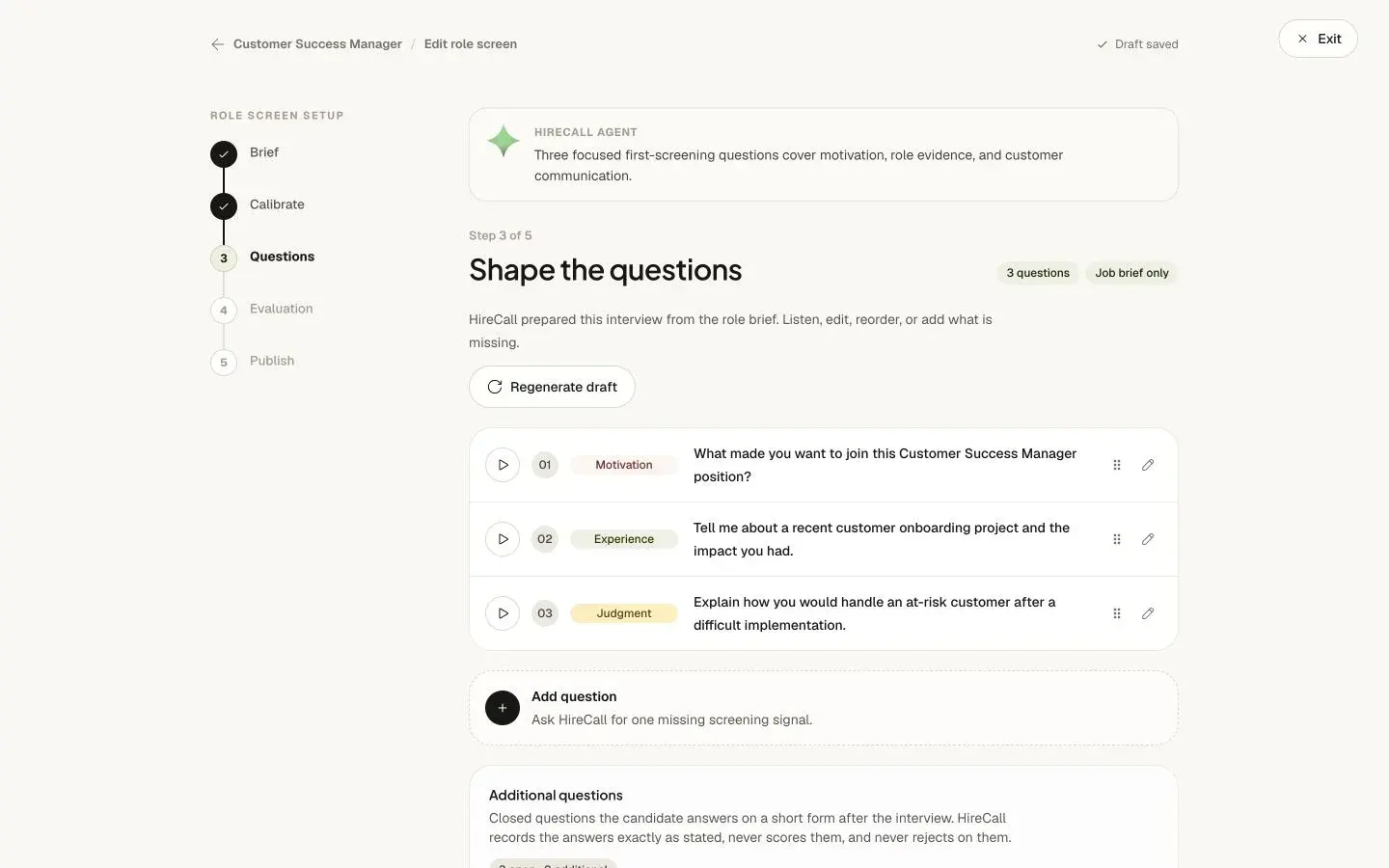
1 · Role context
Begin with the job, not a generic script.
In HireCall’s interview builder, the role brief becomes a focused first interview. Recruiters can listen to, edit, reorder or add questions before inviting anyone, so the conversation stays tied to the work.
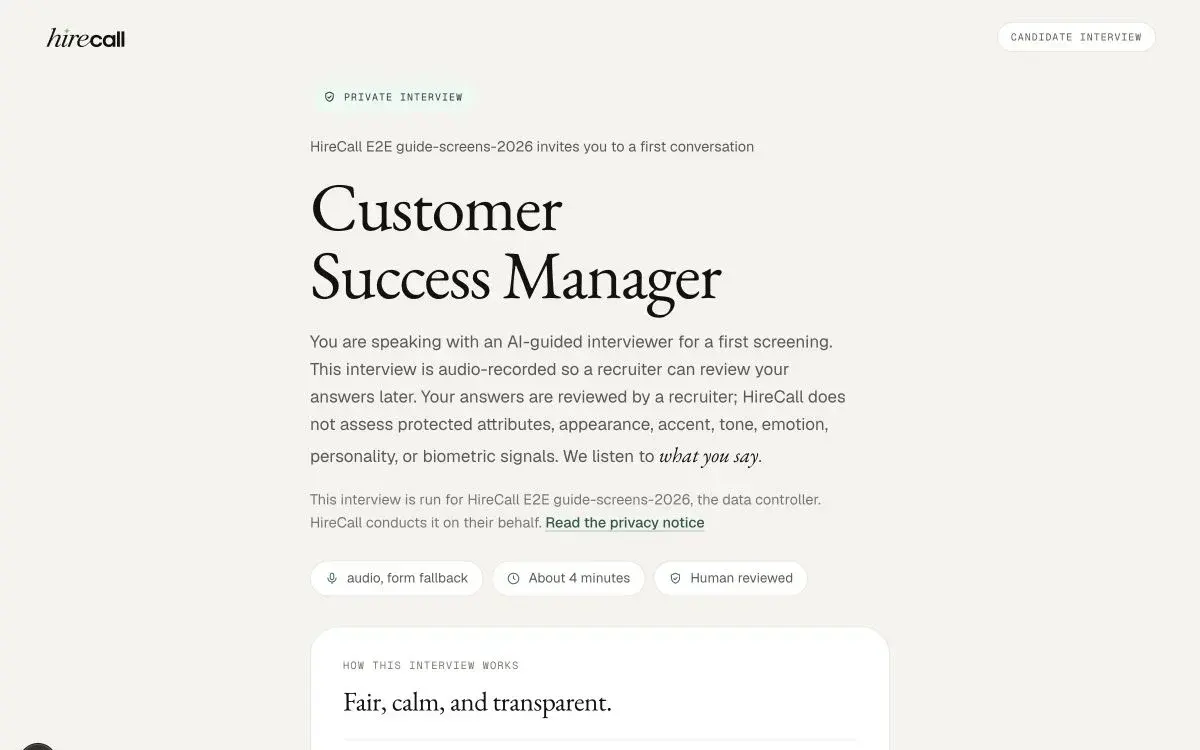
2 · Candidate experience
Set clear expectations before the first question.
Candidates see who is running the interview, how long it takes, what is recorded and how their answers are reviewed. The experience makes clear that HireCall listens to what they say, not how they look or sound.
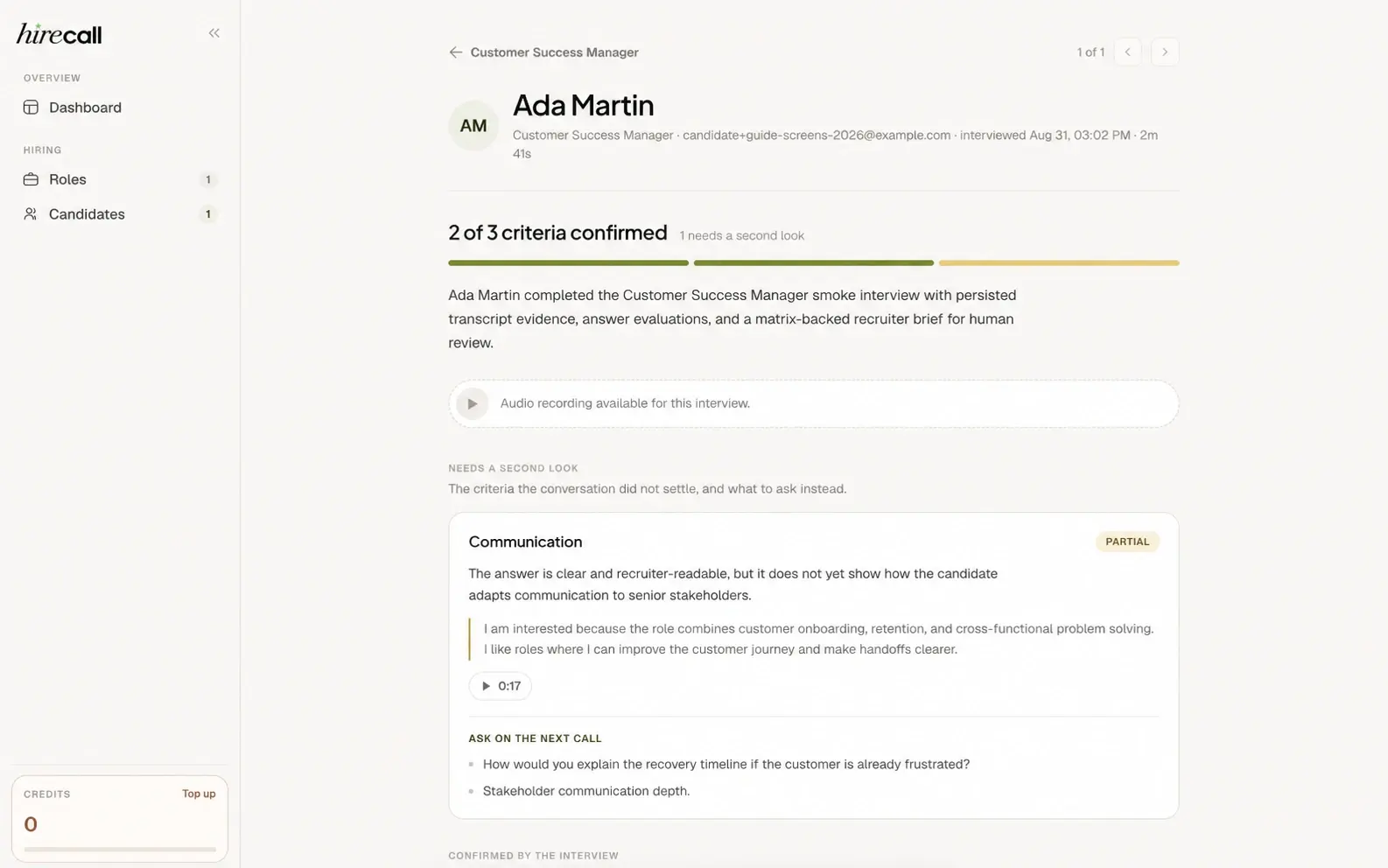
3 · Recruiter brief
Return evidence, not a verdict.
The HireCall recruiter view shows which criteria the conversation confirmed, pairs them with the candidate’s own words and keeps one unresolved area visible for the next call. The decision remains human.
Where AI belongs—and where it does not
Early-stage interviews contain repeatable work: explaining the role, asking relevant questions and recording what candidates say. An AI interviewer can support that work. Interpreting the relevance of a candidate’s experience, weighing nuance, building a relationship and making progression decisions remain human responsibilities.
The UK Government’s guidance on responsible AI in recruitment recommends effective human oversight and warns against unreliable inferences from face, speech or voice data. The practical standard is clear: recruiters must be able to understand the output, inspect its basis and challenge it.
Automate the conversation’s administration, not the decision.
Be transparent with candidates. Keep criteria tied to the role. Provide a route for questions and adjustments. Let recruiters read the evidence behind every brief.
Five questions to ask before choosing an AI interviewer
- 01
Can recruiters inspect the source evidence?
A conclusion should lead back to what the candidate actually said—not stop at a score or unexplained label.
- 02
Are questions and criteria editable for every role?
A generic interview creates generic evidence. The hiring team must own what is relevant to the job.
- 03
Is the candidate told what is happening?
The invitation should explain the format, how the response will be used and where a candidate can ask for help or an adjustment.
- 04
Does the product avoid unreliable proxies?
Facial expression, eye contact, accent or vocal style should not stand in for competence, motivation or role fit.
- 05
Can a human challenge the output?
Recruiters need the context and authority to disagree, investigate an ambiguity and make every progression decision themselves.
When should you use an AI pre-screening interview?
The strongest use case is not “we want AI.” It is “our recruiters need the same first-stage evidence from more candidates than they can call promptly.” Start from that operational problem and the right boundary becomes easier to see.
A strong fit
- Application volume delays first responses.
- Recruiters repeat the same opening questions.
- The role has clear, job-relevant criteria.
- Hiring managers need comparable evidence.
If you want to see how the model works commercially, HireCall’s interview-based pricing keeps the cost tied to completed interviews rather than seats. For a working example, you can also build a screen from one of your open roles.
Questions recruiters ask
AI pre-qualification interview FAQ
What is an AI pre-qualification interview?
It is a first-round, role-specific conversation conducted by an AI interviewer after an application. It gives candidates room to explain relevant experience, motivation and practical constraints before a recruiter decides who progresses.
How is it different from a one-way video interview?
A traditional one-way video interview plays fixed questions and records separate answers for someone to watch later. A conversational AI interviewer can ask focused follow-ups and return a structured written brief linked to the candidate’s answers. HireCall does not analyse facial expressions or body language.
Does an AI pre-qualification interview replace the CV?
No. The CV remains useful context: career history, qualifications and the candidate’s own summary. The interview adds evidence the document cannot carry, especially examples, reasoning, motivation and answers to role-specific questions.
Does it replace the recruiter phone screen?
It can take over the repetitive information-gathering part of an initial screen. It should not replace the human conversation used to build trust, explore nuance, answer candidate questions and make a progression decision.
What should an AI pre-screening interview ask?
Ask only what the next hiring decision needs: evidence of relevant experience, one or two job-specific situations, motivation, availability and genuine practical constraints. Avoid generic personality questions and anything unrelated to the role.
How long should a pre-qualification interview be?
Keep it shorter than a full recruiter interview. The exact length depends on the role, but the scope should stay limited to the few questions needed to decide whether a deeper human conversation is worthwhile.

Written by the HireCall product team
Building evidence-led first interviews for recruiting teams.