
How to create a candidate pre-screening interview.
Turn one job brief into a focused first conversation. This seven-step guide uses a Finance Manager role to show exactly what to define, ask and review.
By HireCall

7 practical steps
From job brief to recruiter-ready evidence.
Worked example
A Finance Manager screen, questions included.
Human reviewed
The interview gathers evidence; people decide.
Start with the decision—not the questions
A useful candidate pre-screening interview does one job: it gives a recruiter enough relevant evidence to decide whether a deeper human conversation is worthwhile.
Before opening an interview builder, complete this sentence: “After this conversation, a recruiter should know…” Keep the answer narrow. For a Finance Manager, the first screen might need to establish ownership of a close process, judgment under uncertainty and motivation for the scope of the role. It does not need to settle every technical skill or leadership question.
The rule
If an answer would not change what the recruiter asks or does next, it probably does not belong in the pre-screen.
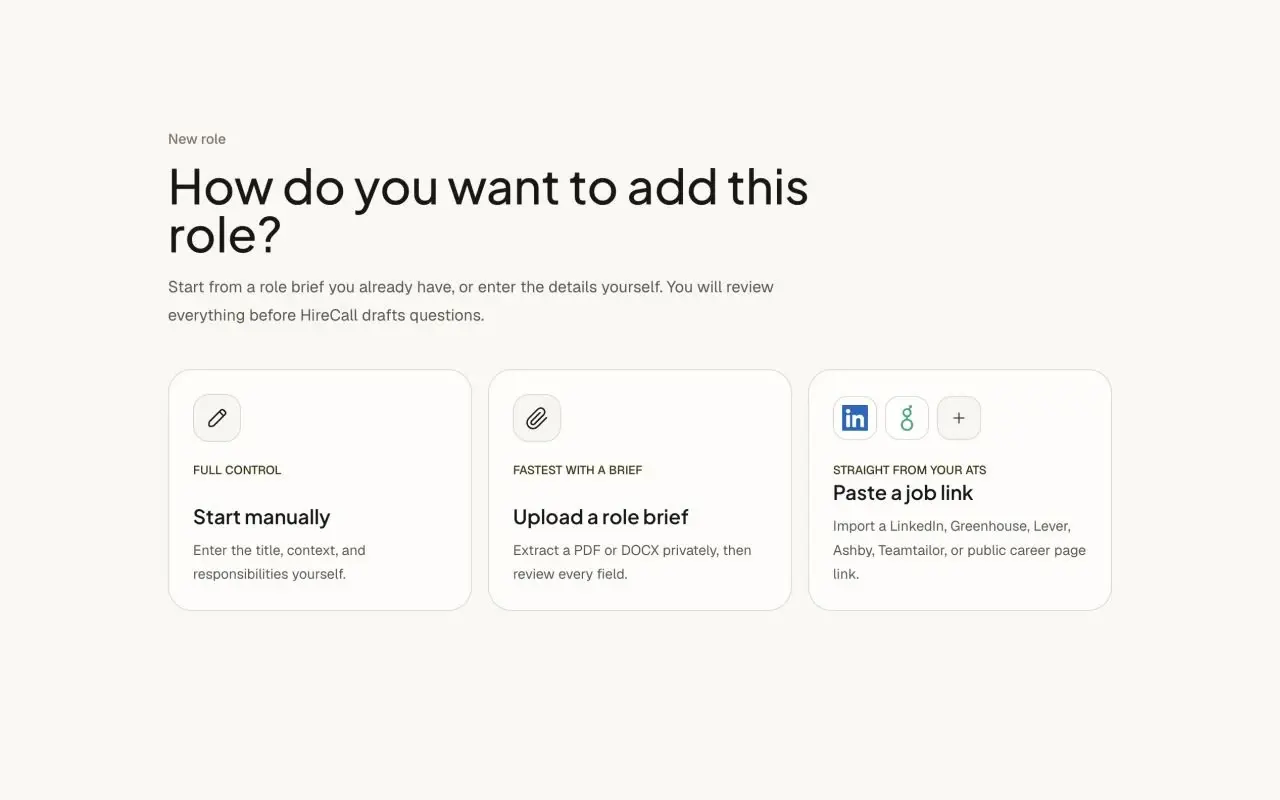
Three ways to start
Use the role information you already have.
Start manually when you want full control, upload a PDF or DOCX role brief for the fastest setup, or paste a public job link from LinkedIn, Greenhouse, Lever, Ashby, Teamtailor or your careers page. HireCall lets you review every field before it drafts the interview.
The seven-step candidate pre-screening process
Use the same sequence for every role, but change the criteria and questions to match the actual work. The worked example below turns a Finance Manager brief into a focused interview.
01Step 01
Define the decision this interview supports
Write down the next decision and who owns it. A clean version is: “The recruiter decides whether the available evidence justifies a full interview with the hiring manager.” That boundary stops the first screen from becoming a compressed final interview.
02Step 02
Choose three to five job-relevant criteria
Read the job description for outcomes and decisions, not adjectives. Replace “commercial,” “strategic” or “great communicator” with evidence someone can explain from their work. Keep only the criteria needed now; leave the rest for the hiring manager.
| Finance criterion | What useful evidence looks like |
|---|---|
| Month-end ownership | What the candidate personally owned, the scale or complexity involved and how they improved accuracy or speed. |
| Judgment under uncertainty | How assumptions were built, challenged and communicated when the financial picture was incomplete. |
| Motivation and scope | Why this role fits the candidate’s next step and whether its responsibilities match what they want to own. |
03Step 03
Write one open question per criterion
The strongest questions ask for a real example and leave room for the candidate to explain context, contribution and outcome. Avoid leading questions, abstract hypotheticals and prompts that contain three unrelated questions.
- “Tell me about a month-end close you owned and how you improved its accuracy or speed.”
- “Describe a cash-flow or budgeting decision you made with incomplete information.”
- “What made you want to join this Finance Manager position?”
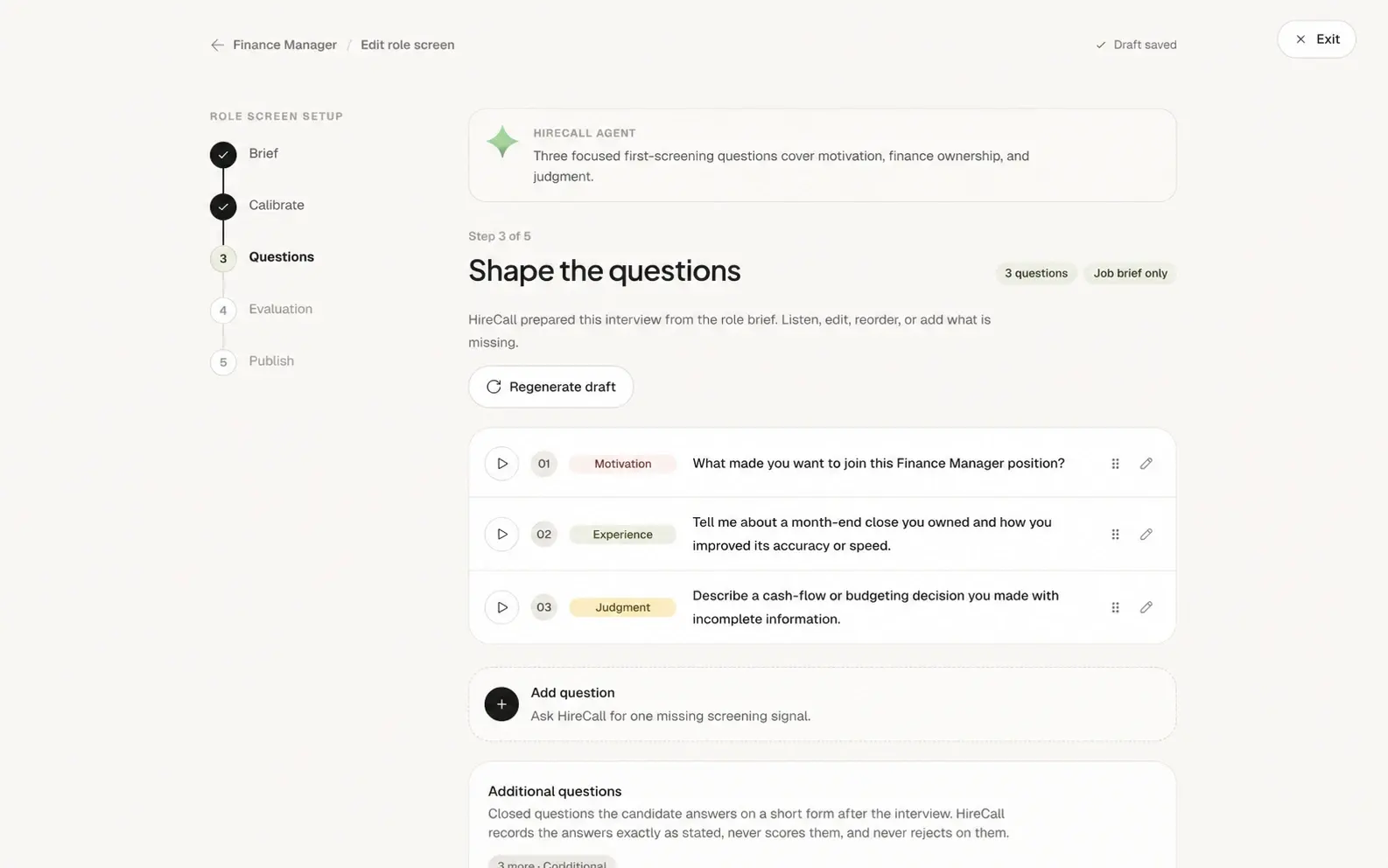
Finance example
Review the generated questions before anyone is invited.
HireCall turns the role brief into a draft conversation. The hiring team can listen to, edit, reorder or add questions so every prompt remains tied to the work and the next decision.
04Step 04
Calibrate the follow-ups
For each question, define what the first answer must make clear. If a candidate mentions improving month-end close, a useful follow-up might ask what they personally changed, how many entities were involved or what the measurable result was. Follow-ups should resolve ambiguity, not test whether someone guesses a hidden ideal answer.
05Step 05
Explain the experience to candidates
The invitation and welcome screen should say who is conducting the interview, approximately how long it takes, what is recorded, how answers will be reviewed and where a candidate can request help or an alternative route. Transparency is part of interview quality, not a legal note to hide at the bottom.
For a broader framework, read our guide to responsible AI pre-qualification interviews.
06Step 06
Publish and test the interview
Complete the interview once as if you were a candidate. Check the timing, listen for awkward wording and make sure every follow-up has a clear purpose. Then freeze that version for the role so candidates receive a comparable evidence-gathering process.
07Step 07
Review evidence, not a score
A useful recruiter brief shows what the conversation established, links each conclusion to the candidate’s own words and keeps uncertainty visible. The recruiter should be able to disagree, inspect the source and turn every unresolved point into a sharper human follow-up.
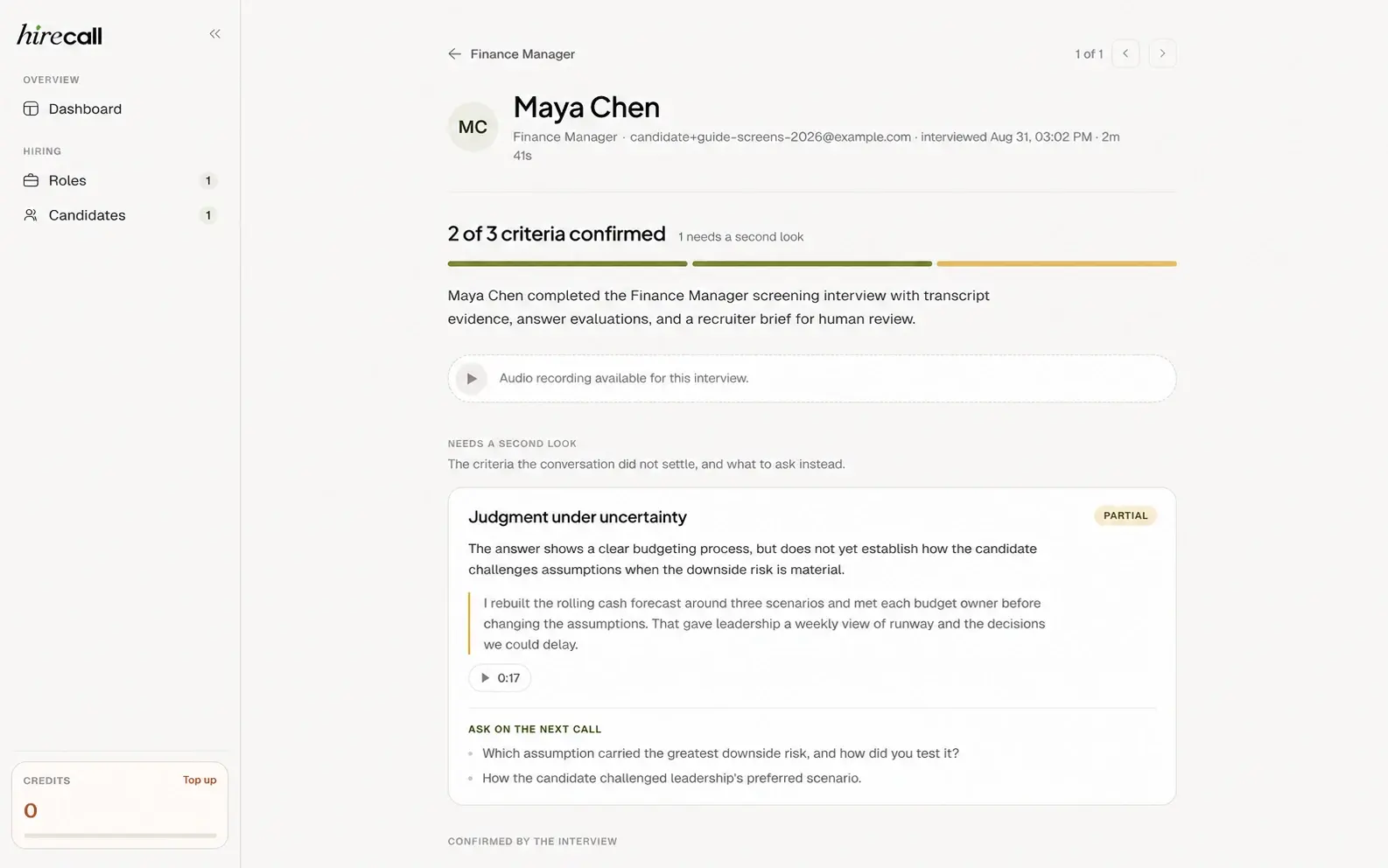
Recruiter output
Carry the open question into the next call.
This example confirms two criteria and leaves judgment under uncertainty open. Instead of hiding that gap behind a score, the brief shows the evidence and suggests what the recruiter should explore next.
Five pre-screening mistakes to avoid
Turning the job description into a quiz
A pre-screen should establish relevant evidence, not reward the person who memorised the most technical definitions.
Asking broad questions without a follow-up plan
“Tell me about yourself” creates inconsistent evidence. Tie every question to one criterion and know what detail is still missing.
Trying to settle the whole hiring decision
Keep the scope narrow. The output should improve the next human conversation, not pretend to replace it.
Hiding how the interview works
Candidates should understand who will review their answers, what is recorded and how to request help or an alternative route.
Reducing answers to a score
A number removes context. Recruiters need the candidate’s own words, the basis for each conclusion and the unresolved questions.
Before you publish
- Every question maps to a job-relevant criterion.
- The interview is materially shorter than the human interview.
- Candidates know what is recorded and who reviews it.
- Recruiters can inspect the source answer behind the brief.
- A person owns every progression decision.
Questions recruiters ask
Candidate pre-screening interview FAQ
What is a candidate pre-screening interview?
It is a focused first conversation used to gather the small amount of job-relevant evidence a recruiter needs before deciding whether to hold a deeper interview. It usually covers motivation, relevant experience and practical constraints.
How many pre-screening questions should you ask?
Start with three to five open questions. Each should map to one criterion that genuinely affects the next decision. Add short practical questions only when the answers are necessary at this stage.
How long should a candidate pre-screening interview take?
Keep it materially shorter than a full recruiter interview. For most roles, a focused conversation can stay around 10 to 15 minutes when questions are limited to the evidence needed for the next step.
Should every role use the same pre-screening questions?
No. The process can stay consistent, but the criteria and questions should change with the work. A Finance Manager, Customer Success Manager and Sales Development Representative require different evidence.
Can AI run the first pre-screening interview?
Yes, when the hiring team owns the criteria, candidates understand the experience and recruiters can inspect the source evidence. AI can conduct the repeatable first conversation; people should interpret nuance and make every progression decision.
Understand what the interview adds beyond a CV.
Read our complete guide to AI pre-qualification interviews for the benefits, boundaries and responsible-use framework.

Written by the HireCall product team
Building evidence-led first interviews for recruiting teams.